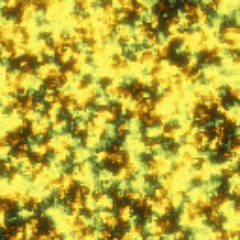
PL. 104 · LATTICES / LATTICE / COUPLED PHASES
Kuramoto Oscillator Lattice
Yoshiki Kuramoto, 1975
OPEN THE LIVE PLATE ▸DEFINITION
θ̇ᵢⱼ = ωᵢⱼ + (K/4)·Σ₍ᵤᵥ₎ sin(θᵤᵥ − θᵢⱼ)
ωᵢⱼ frozen from N(μ, σ);   r = |⟨e^{iθ}⟩|
NOTES
Kuramoto asked when a crowd of oscillators, each with its own natural pace, falls into step — fireflies, pacemaker cells, applauding hands. Each site here carries a phase and a private frequency drawn once and kept; the only interaction is a pull toward the four neighbours through the sine of the difference. Quenched from disorder, the lattice does not simply settle: it leaves phase vortices — points the phase winds around, where every colour of the wheel meets — that spiral, drift and annihilate in pairs. Coupling too weak and disorder shimmers forever; strong enough and synchrony spreads until the whole plate turns one slowly cycling colour. That transition is measured, not narrated: when the order parameter r crosses 0.92 the lattice has entrained, and a fresh disorder is poured.
PROVENANCE
- Origin
- Y. Kuramoto, "Self-entrainment of a population of coupled non-linear oscillators", International Symposium on Mathematical Problems in Theoretical Physics, Lecture Notes in Physics 39, Springer, 1975, 420–422
- Standing
- Public domain mathematical physics. No patent
- Constants
- K = 1.1 with σ = 0.35 is strong enough to organise and too weak to entrain, so the plate lives on the boundary the theory is about. The order parameter r is the model talking about itself, and the reseed at r > 0.92 is its own transition used as the life cycle
- Source
- doi:10.1007/BFb0013365