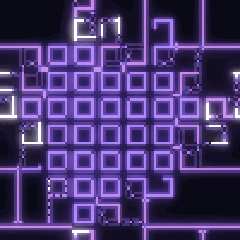
PL. 110 · AUTOMATA / AUTOMATON / SELF-REPRODUCING
Langton Self-Reproducing Loop
Christopher G. Langton, 1984
OPEN THE LIVE PLATE ▸DEFINITION
8 states, von Neumann neighbourhood, 219 transitions CNESW → C′
rotation symmetric; replication period 151 generations
NOTES
Von Neumann proved self-reproduction needs no magic with a machine of 29 states nobody could run; Codd cut it to 8; Langton cut the idea to its heart — a loop of sheathed wire holding its own description as a circulating tape of gene signals, copying itself into a daughter loop every 151 steps. The colony spreads until loops run out of room, and the interior ones, unable to reproduce, retire into stillness: the growth leaves a coral of dead loops behind the living frontier, which Langton pointed to as the interesting part. The 219-rule table is carried as data, exactly as printed, and the same table drives both engines.
PROVENANCE
- Origin
- C. G. Langton, "Self-reproduction in cellular automata", Physica D 10(1–2), 1984, 135–144
- Table
- The transition table is Table 1 of the paper, via the Sayama–Bachmutsky transcription that Golly distributes — the table is the mathematics, carried as data the way sprott carries his codes; no library code runs here
- Standing
- Public domain automaton. No patent
- Constants
- The initial loop is the 86-cell configuration from the paper, placed and turned by seed — the table is rotation symmetric, so a turned loop runs identically turned
- Source
- doi:10.1016/0167-2789(84)90256-2