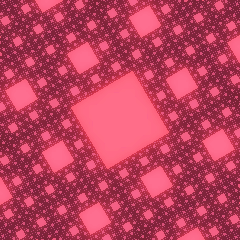
PL. 107 · FRACTALS / FRACTAL / SELF-SIMILAR
Sierpiński Carpet
Wacław Sierpiński, 1916
OPEN THE LIVE PLATE ▸DEFINITION
divide [0,1]² into 3×3, remove the centre, recurse
x ∈ carpet ⇔ no k has ⌊3ᵏx⌋ ≡ ⌊3ᵏy⌋ ≡ 1 (mod 3)
dim_H = log 8 / log 3 ≈ 1.8928
NOTES
Sierpiński built it as a curve containing a continuous image of every curve — a universal object, published two years before anyone could draw more than three levels of it by hand. The construction is base three: a point survives unless, at some depth, both of its ternary digits read 1 at once, which is the centre cell. What survives has area zero and infinite perimeter, and every part of it is the whole scaled by a third. The plate colours each removed square by the depth at which it fell, walks the frame slowly round and breathes the zoom, and tiles — the carpet is periodic under its own subdivisions, which is also what makes it a rewarding composition operand.
PROVENANCE
- Origin
- W. Sierpiński, "Sur une courbe cantorienne qui contient une image biunivoque et continue de toute courbe donnée", Comptes Rendus Acad. Sci. Paris 162, 1916, 629–632
- Standing
- Public domain since 1916. No patent. The 1915 companion note is the triangle, not the carpet — a citation that splices the two is wrong in a way this atlas cares about
- Constants
- Depth is the recursion cut-off — the slider ceiling is the loop bound, mandelbrot fashion. Below depth 3 the figure is a grid, not yet a fractal
TOUCHDESIGNER · GLSL
The same shader this plate runs, reframed for a GLSL TOP. Pasted bare it renders the published constants as a still frame; wire absTime.seconds into u_t on the Vectors page to animate it.
// FORMA — PL. 107 · SIERPIŃSKI CARPET — Wacław Sierpiński, 1916
//   divide [0,1]² into 3×3, remove the centre, recurse
//   x ∈ carpet ⇔ no k has ⌊3ᵏx⌋ ≡ ⌊3ᵏy⌋ ≡ 1 (mod 3)
//   dim_H = log 8 / log 3 ≈ 1.8928
// TouchDesigner port — paste into a GLSL TOP's pixel shader. Set the
// resolution on the TOP's Common page. As pasted it renders the published
// constants as a still frame; to animate, add a uniform named u_t on the
// GLSL TOP's Vectors 1 page with the expression absTime.seconds.
// Constants are consts — edit to tweak; comments give the measured range.
// Written from the published mathematics, not adapted from any code.

#define u_res (uTDOutputInfo.res.zw)
uniform float u_t;               // absTime.seconds on the Vectors page; unset = still

const float u_phase = 0.5981;    // this plate's own grid phase, 0..1
// FORMA's FRACTALS accent as cosine-gradient coefficients
const vec3 u_pal_a = vec3(0.46, 0.1389, 0.1912);
const vec3 u_pal_b = vec3(0.5, 0.151, 0.2078);
const vec3 u_pal_c = vec3(1, 1, 1);
const vec3 u_pal_d = vec3(0, 0.05, 0.1);

const float p_depth = 5.0;         // recursion depth · live 2 .. 7
const float p_zoom  = 1.2;         // zoom · live 0.8 .. 3
const float p_spin  = 0.1;         // rotation speed · live 0 .. 0.5

/* The order's ramp — the same cosine formulation the JS kit uses, so a
   plate keeps its classification colour in either language. */
vec3 ramp(float t){
  return clamp(u_pal_a + u_pal_b * cos(6.28318530718 * (u_pal_c * t + u_pal_d)), 0.0, 1.0);
}

/* Sawtooth and triangle on this plate's phase, mirroring the JS kit. */
float cycle(float t, float period){ return fract(t / period + u_phase); }
float pingpong(float t, float period){
  float u = cycle(t, period);
  return u < 0.5 ? u * 2.0 : 2.0 - u * 2.0;
}


vec3 plate(vec2 uv){
  float ar = u_res.y / u_res.x;
  float ang = u_phase * 6.283 + u_t * p_spin;
  float ca = cos(ang), sa = sin(ang);
  float sc = p_zoom * (0.75 + 0.5 * pingpong(u_t * 0.04, 1.0));
  vec2 c = vec2(uv.x - 0.5, (uv.y - 0.5) * ar);
  vec2 q = fract(vec2(c.x * ca - c.y * sa, c.x * sa + c.y * ca) * sc + 0.5);
  float d = floor(p_depth + 0.5);
  /* Constant loop bound at the slider ceiling, break on the live value —
     mandelbrot fashion. */
  for (int k = 0; k < 7; k++){
    if (float(k) >= d) break;
    q *= 3.0;
    vec2 cell = floor(q);
    if (cell.x == 1.0 && cell.y == 1.0) return ramp(1.02 - float(k) * 0.055);
    q -= cell;
  }
  return ramp(0.85) * 0.28;
}

out vec4 fragColor;
void main(){
  // FORMA's uv runs y-down, matching its canvas; TD's vUV runs up
  vec2 uv = vec2(vUV.s, 1.0 - vUV.t);
  fragColor = TDOutputSwizzle(vec4(plate(uv), 1.0));
}
NUKE · BLINKSCRIPT
The same shader this plate runs, transpiled to a BlinkScript kernel. Paste it into a BlinkScript node's Kernel Source and press Recompile; every constant arrives as a knob at its published value, and u_t animates with the expression frame/24. Compiled and rendered in Nuke 17.1, then compared against this plate on the page.
// FORMA — PL. 107 · SIERPIŃSKI CARPET — Wacław Sierpiński, 1916
//   divide [0,1]² into 3×3, remove the centre, recurse
//   x ∈ carpet ⇔ no k has ⌊3ᵏx⌋ ≡ ⌊3ᵏy⌋ ≡ 1 (mod 3)
//   dim_H = log 8 / log 3 ≈ 1.8928
// Nuke port — a BlinkScript kernel. Paste into a BlinkScript node's Kernel
// Source and press Recompile. Every constant arrives as a knob at its published
// value (the comment gives the measured range); u_t is a knob too — animate it
// with the expression frame/24 or leave it at 0 for the still frame. Written
// from the published mathematics, not adapted from any code.
// Transpiled from the shader this plate runs on the page (GLSL ES 3.00):
// vec → float2/3/4, swizzles expanded, GLSL builtins Blink lacks written out
// as forma_ functions, float literals suffixed. Compiled and rendered in a
// real Nuke (17.1v1) and compared against this plate on the page: 34 of 34.
//
// plate() and its helpers are written to a single exit — the loop that runs
// once. That is not a style: Blink 17.1 drops a conditional early return from
// a called function while Vectorize is on, which is the node default, with no
// warning and no error. Written this way it paints correctly as pasted.

kernel Forma_sierpinski : ImageComputationKernel<ePixelWise>
{
  Image<eWrite> dst;

param:
  float u_t;             // seconds; 0 is the still frame
  float p_depth; // recursion depth · live 2 .. 7
  float p_zoom;  // zoom · live 0.8 .. 3
  float p_spin;  // rotation speed · live 0 .. 0.5

local:
  float2 u_res;
  float u_phase;
  float3 u_pal_a, u_pal_b, u_pal_c, u_pal_d;

  void define(){
    defineParam(u_t, "u_t", 0.0f);
    defineParam(p_depth, "p_depth", 5.0f);
    defineParam(p_zoom, "p_zoom", 1.2f);
    defineParam(p_spin, "p_spin", 0.1f);
  }

  void init(){
    u_res = float2(float(dst.bounds.width()), float(dst.bounds.height()));
    u_phase = 0.5981f;    // this plate's own grid phase, 0..1
    // FORMA's FRACTALS accent as cosine-gradient coefficients
    u_pal_a = float3(0.46f, 0.1389f, 0.1912f);
    u_pal_b = float3(0.5f, 0.151f, 0.2078f);
    u_pal_c = float3(1.0f, 1.0f, 1.0f);
    u_pal_d = float3(0.0f, 0.05f, 0.1f);
  }

  /* GLSL builtins Blink lacks, written as templates rather than overload sets.
     Blink's operators return expression templates (Swizzle<float,N>), so a call
     passing an expression cannot resolve against an overload set on float2
     against float3 — measured in Nuke 17.1: a float2 expression is ambiguous
     between the two, while scalar-against-vector resolves. A template deduces
     the expression's own type, so the ambiguity cannot arise. */
  template <class T> T forma_fract(T v){ return v - floor(v); }
  template <class T, class S> T forma_mod(T x, S y){ return x - y * floor(x / y); }
  /* Blink's own min/max/clamp take no scalar bound against a vector, which GLSL
     does; v * 0.0f + b is that bound at the vector's own width, and collapses to
     b when v is a scalar, so one template serves both. */
  template <class T, class S> T forma_min(T a, S b){ return min(a, a * 0.0f + b); }
  template <class T, class S> T forma_max(T a, S b){ return max(a, a * 0.0f + b); }
  template <class T, class S> T forma_clamp(T v, S lo, S hi){ return clamp(v, v * 0.0f + lo, v * 0.0f + hi); }
  int forma_min(int a, int b){ return min(a, b); }
  int forma_max(int a, int b){ return max(a, b); }
  /* GLSL step(edge, x) is 1 where x >= edge; floor(sign(x - e) * 0.5 + 1) is
     that exactly, equality included, out of builtins Blink does have. */
  template <class T, class S> T forma_step(S e, T x){ return floor(sign(x - e) * 0.5f + 1.0f); }
  template <class T, class S> T forma_smoothstep(S a, S b, T x){
    T t = forma_clamp((x - a) / (b - a), 0.0f, 1.0f);
    return t * t * (3.0f - 2.0f * t);
  }
  template <class T> float forma_distance(T a, T b){ return length(a - b); }
  float forma_tanh(float x){ float e = exp(2.0f * x); return (e - 1.0f) / (e + 1.0f); }
  float forma_radians(float d){ return d * 0.01745329252f; }
  // the page's hash2 is exact uint32; Blink has int, so the shifts are made
  // logical by masking and the read-back is lifted into 0 .. 2^32
  /* A uint read back as a float. Blink has no unsigned type, so a value past
     2^31 arrives as a negative int and float() of it is negative. Measured on
     gabor, whose own generator then returned uniforms in [-0.5, 0.5) and drew
     a different picture — it compiled, it rendered, and only comparing it with

  /* The order's ramp — the same cosine formulation the JS kit uses, so a
     plate keeps its classification colour in either language. */
  float3 ramp(float t){
    return forma_clamp(u_pal_a + u_pal_b * cos(6.28318530718f * (u_pal_c * t + u_pal_d)), 0.0f, 1.0f);
  }

  /* Sawtooth and triangle on this plate's phase, mirroring the JS kit. */
  float cycle(float t, float period){ return forma_fract(t / period + u_phase); }
  float pingpong(float t, float period){
    float u = cycle(t, period);
    return u < 0.5f ? u * 2.0f : 2.0f - u * 2.0f;
  }


  float3 plate(float2 uv){
    float3 forma_r = float3(0.0f, 0.0f, 0.0f);
    bool forma_done = false;
    for (int forma_once = 0; forma_once < 1; forma_once++){
      float ar = u_res.y / u_res.x;
      float ang = u_phase * 6.283f + u_t * p_spin;
      float ca = cos(ang);
      float sa = sin(ang);
      float sc = p_zoom * (0.75f + 0.5f * pingpong(u_t * 0.04f, 1.0f));
      float2 c = float2(uv.x - 0.5f, (uv.y - 0.5f) * ar);
      float2 q = forma_fract(float2(c.x * ca - c.y * sa, c.x * sa + c.y * ca) * sc + 0.5f);
      float d = floor(p_depth + 0.5f);
      /* Constant loop bound at the slider ceiling, break on the live value —
         mandelbrot fashion. */
      for (int k = 0; k < 7; k++){
        if (float(k) >= d) break;
        q *= 3.0f;
        float2 cell = floor(q);
        if (cell.x == 1.0f && cell.y == 1.0f) { forma_r = ramp(1.02f - float(k) * 0.055f); forma_done = true; break; }
        q -= cell;
      }
      if (forma_done) break;
      { forma_r = ramp(0.85f) * 0.28f; break; }
    }
    return forma_r;
  }

  void process(int2 pos){
    // FORMA's uv runs y-down like its canvas; Nuke's rows run up
    float2 uv = float2((float(pos.x) + 0.5f) / u_res.x, 1.0f - (float(pos.y) + 0.5f) / u_res.y);
    float3 c = plate(uv);
    dst() = float4(c.x, c.y, c.z, 1.0f);
  }
};