DEFINITION
empty → empty
electron head → electron tail
electron tail → conductor
conductor → electron head if 1 or 2 of its 8 neighbours are heads
NOTES
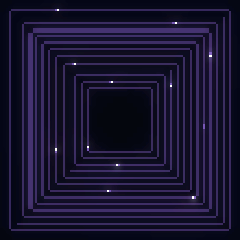
Four states and one counting rule, and the lattice becomes a circuit board. Silverman wrote it in 1987 for Phantom Fish Tank, and the reason it is remembered while most cellular automata are not is that the rule was designed backwards from what it had to support: an electron is a head followed by a tail, the tail is what stops it reversing into the wire it just left, and the one-or-two-heads condition is exactly what makes a junction behave like a diode instead of a short. It is Turing complete, and people have built working computers in it. What is shown here is the primitive everything else is made from — closed loops of conductor, each carrying its own circulating electron, so the ring length is the clock period and rings of different size beat against one another forever without any of them drifting.
PROVENANCE
- Origin
- Brian Silverman, 1987, written as part of his program Phantom Fish Tank
- Popularised
- A. K. Dewdney, “Computer Recreations: the cellular automata programs that create wireworld, rugworld and other diversions”, Scientific American 262(1), January 1990, 146–149 — the column that took it beyond its author’s own program
- Standing
- Public domain — four transition rules
- The circuit
- The rings are this plate’s own construction, not a reproduction of anyone’s design: a rectangular outline is a closed conductor path whose cells are adjacent only to their own neighbours along the ring, so an electron placed head-ahead-of-tail circulates one way forever. The period of each ring is exactly its perimeter in cells, which is why the plate can state the periods rather than measure them
- Constants
- Rings are spaced three cells apart so no ring can trigger its neighbour