PL. 100 · AUTOMATA / LATTICE / CONTINUOUS CA
Lenia
Bert Wang-Chak Chan, 2019 · preprint 2018
OPEN THE LIVE PLATE ▸DEFINITION
U = K ∗ A,   K(n) = K_S(‖n‖₂ / R) / |K_S|
K_S(r; β) = β_⌊Br⌋ · K_C(Br mod 1),   K_C(r) = exp(4 − 4 / (4r(1−r)))
G(u; μ, σ) = 2·exp(−(u−μ)² / (2σ²)) − 1
A^(t+Δt) = [ A^t + Δt · G(U) ]₀¹,   Δt = 1/T
NOTES
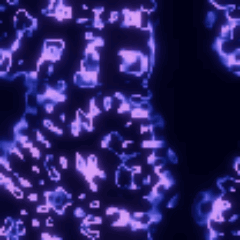
The Game of Life with every discrete thing in it taken to the limit. A cell holds a real number in [0,1] instead of a bit; the neighbourhood is a smooth ring of radius R instead of eight squares; a generation is a fraction 1/T of one instead of a whole step. Convolve the world with the ring to get a potential, feed that through a bell curve centred on μ that returns growth between −1 and +1, add a slice of it, clip. That is the entire rule, and out of it Chan catalogued more than four hundred species in eighteen families — soft, bilateral, metameric things that swim, rotate and recover from being cut. The famous one is Orbium, a smooth glider. This plate does not paste Orbium in: a catalogued creature is a table of measured cell values, and the premise here is that everything is written from the mathematics. It runs Chan’s own discovery procedure instead — a random soup, left to organise itself — and pours a fresh one when the old one has had its run.
PROVENANCE
- Origin
- B. Wang-Chak Chan, “Lenia — Biology of Artificial Life”, arXiv:1812.05433 (v1 13 December 2018, v3 May 2019); published as Complex Systems 28(3), 2019, 251–286, doi:10.25088/ComplexSystems.28.3.251. The name is from Latin lenis, “smooth”
- Sequel
- B. Wang-Chak Chan, “Lenia and Expanded Universe”, Artificial Life Conference Proceedings 32, 2020, 221–229; arXiv:2005.03742 — higher dimensions, multiple kernels and channels, and self-replication. Not implemented here: this plate is the 2019 system
- Standing
- Public domain — a convolution and a bell curve. No patent has ever applied
- Constants
- μ = 0.15, σ = 0.016 are Orbium’s published growth parameters (Fig. 6); T = 10 and R = 13 are the time and space resolutions of Chan’s own figures. The kernel is rank 2 rather than Orbium’s rank 1, which is a measurement rather than a preference — see the source
- Source
- arXiv:1812.05433