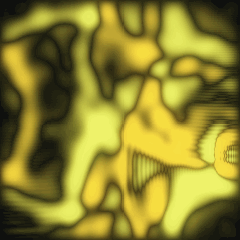
PL. 99 · LATTICES / PDE / DAMPED WAVE
Wave Equation on a Lattice
Jean le Rond d’Alembert, 1747 (the string) · Leonhard Euler, 1761 (the membrane)
OPEN THE LIVE PLATE ▸DEFINITION
∂²u/∂t² + γ ∂u/∂t = c²∇²u + F(x, t)

uⁿ⁺¹ = [ 2uⁿ − (1−d)uⁿ⁻¹ + C²∇²ₕuⁿ ] / (1+d)
C = cΔt/h ≤ 1/√2,  d = γΔt/2
NOTES
d’Alembert’s 1747 memoir on the stretched string is where the wave equation first appears in print, and he solved it in one space dimension: the answer is two arbitrary shapes travelling in opposite directions, and they need not be given by any formula — which is the argument with Euler and Bernoulli that ran for the next fifty years. The membrane is Euler’s, fourteen years later, and it is the harder object: in two dimensions a disturbance does not simply pass, it leaves a wake. This plate integrates the damped, driven membrane by the leapfrog scheme — displacement now from displacement one step ago and two steps ago, with the five-point Laplacian — on a square fixed at its rim, and rains on it. Every ring you see cross another is superposition, which is the whole content of the equation being linear; every ring that comes back off the edge is the fixed boundary. The Courant number C is the only dial that can destroy the plate, and where it destroys it is not arbitrary: information on the lattice travels one cell per step at most, so a scheme asked to propagate faster than its own stencil cannot be stable. Measured on this plate, C = 0.70 runs for fifteen seconds without growing and C = 0.71 overflows in forty-five frames; the analysis says 1/√2 = 0.7071, and the slider stops at 0.68.
PROVENANCE
- Origin (1-D)
- J. le R. d’Alembert, “Recherches sur la courbe que forme une corde tenduë mise en vibration” and “Suite des recherches…”, Histoire de l’Académie royale des sciences et belles-lettres de Berlin 3 (année 1747), 214–219 and 220–249 — presented in 1747, printed in 1749
- Origin (2-D)
- L. Euler, “De motu vibratorio tympanorum” (E302), read to the Berlin Academy 22 January 1761 and to the Petersburg Academy 17 May 1762, printed in Novi Commentarii academiae scientiarum Petropolitanae 10 (1766), 243–260. The first treatise devoted to the vibrating membrane, and where the two-dimensional wave equation is solved
- The scheme
- The explicit second-order central difference in space and time — “leapfrog”, and the same recurrence Störmer–Verlet integration gives for the semi-discretised system. Its stability condition is R. Courant, K. Friedrichs & H. Lewy, “Über die partiellen Differenzengleichungen der mathematischen Physik”, Mathematische Annalen 100 (1928), 32–74
- Standing
- Public domain — an eighteenth-century partial differential equation and a 1928 stability criterion
- The forcing is ours
- d’Alembert and Euler wrote the homogeneous equation. F is a schedule of raindrops added here so the plate has something to propagate, and it is a staging decision rather than published mathematics. Everything between drops is theirs
- Constants
- C is the Courant number cΔt/h and the slider stops at 0.68 because the scheme is unconditionally unstable above 1/√2. Damping is how many old rings survive; rain and drop width are the shape dials