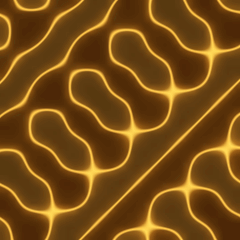
PL. 126 · FIELDS / SURFACE / TRIPLY PERIODIC
Schwarz D Surface
H. A. Schwarz, 1865 · nodal form: von Schnering & Nesper, 1991
OPEN THE LIVE PLATE ▸DEFINITION
d(x, y, z) = sin x·sin y·sin z + sin x·cos y·cos z + cos x·sin y·cos z + cos x·cos y·sin z
walls where |d| < δ, sliced on z = ω·t
NOTES
Schwarz solved the Plateau problem for four consecutive edges of a regular tetrahedron in 1865, and the surface spanning that frame extends by repeated reflection across its own edges into a triply periodic lattice with no straight lines and no self-intersections, splitting space into two congruent labyrinths that never touch — the same structural class as the gyroid, found a century later. Schoen named this one the diamond surface: each labyrinth threads through space with the fourfold coordination of a carbon bond, two interpenetrating diamond nets rather than the simple cubic pair the P surface separates. The plate drifts a plane slice through the third axis exactly as the gyroid plate does, so the chambers of one labyrinth open, pinch and hand over to the other. D, the gyroid and P are one Bonnet associate family under the same continuous bending: 0 degrees here for D, about 38.015 degrees for the gyroid, 90 degrees for P — the gyroid the only associate angle besides the two ends where the surface stays free of self-intersection. Honesty about the formula: the true minimal D surface has no closed form; the sine-cosine field here is the nodal approximation crystallographers use in place of it, and the wall drawn is its zero set thickened to δ.
PROVENANCE
- Origin
- H. A. Schwarz, solution to the Plateau problem for four edges of a regular tetrahedron, announced 1865 and worked out at length across two further memoirs, collected in Gesammelte Mathematische Abhandlungen, Springer, Berlin, 1890, vol. 1
- Approximation
- H. G. von Schnering & R. Nesper, "Nodal surfaces of Fourier series: fundamental invariants of structured matter", Z. Physik B — Condensed Matter 83, 407–412, 1991 — the same paper cited on the gyroid entry for its own nodal form. Their published single-term D approximation is cos x·cos y·cos z − sin x·sin y·sin z; the level set drawn here is that same surface — checked by direct substitution to equal −√2 times their form once x, y and z are each shifted by one eighth of a turn (π/4), the ordinary freedom to place a cubic nodal surface origin at a different symmetry point of the lattice, and confirmed algebraically since expanding sin(x+y+z) shows the form used here is exactly sin(x+y+z) + 2 sin x sin y sin z
- Standing
- Public domain — nineteenth-century mathematics and a Fourier truncation of it published in a physics journal. No patent
- Constants
- Scale counts surface periods across the frame; δ is wall thickness in field units, where |d| tops out at √2 ≈ 1.414 (checked by direct search over the domain, matching the bound the single-term form gives algebraically) — close enough to the gyroid |g| bound of 1.5 that the same δ range carries over unchanged here, and it measured fully live end to end across the whole declared box
- Source
- doi:10.1007/BF01313411
TOUCHDESIGNER · GLSL
The same shader this plate runs, reframed for a GLSL TOP. Pasted bare it renders the published constants as a still frame; wire absTime.seconds into u_t on the Vectors page to animate it.
// FORMA — PL. 126 · SCHWARZ D SURFACE — H. A. Schwarz, 1865 · nodal form: von Schnering & Nesper, 1991
//   d(x, y, z) = sin x·sin y·sin z + sin x·cos y·cos z + cos x·sin y·cos z + cos x·cos y·sin z
//   walls where |d| < δ, sliced on z = ω·t
// TouchDesigner port — paste into a GLSL TOP's pixel shader. Set the
// resolution on the TOP's Common page. As pasted it renders the published
// constants as a still frame; to animate, add a uniform named u_t on the
// GLSL TOP's Vectors 1 page with the expression absTime.seconds.
// Constants are consts — edit to tweak; comments give the measured range.
// Written from the published mathematics, not adapted from any code.

#define u_res (uTDOutputInfo.res.zw)
uniform float u_t;               // absTime.seconds on the Vectors page; unset = still

const float u_phase = 0.5334;    // this plate's own grid phase, 0..1
// FORMA's FIELDS accent as cosine-gradient coefficients
const vec3 u_pal_a = vec3(0.46, 0.3031, 0.11);
const vec3 u_pal_b = vec3(0.5, 0.3294, 0.1196);
const vec3 u_pal_c = vec3(1, 1, 1);
const vec3 u_pal_d = vec3(0, 0.05, 0.1);

const float p_scale = 3.0;         // periods across · live 1.5 .. 6
const float p_thick = 0.25;        // δ — wall thickness · live 0.08 .. 0.6
const float p_drift = 0.25;        // ω — slice drift · live 0.05 .. 0.8
const float p_tilt  = 0.18;        // plane tilt · live 0 .. 0.5

/* The order's ramp — the same cosine formulation the JS kit uses, so a
   plate keeps its classification colour in either language. */
vec3 ramp(float t){
  return clamp(u_pal_a + u_pal_b * cos(6.28318530718 * (u_pal_c * t + u_pal_d)), 0.0, 1.0);
}

/* Sawtooth and triangle on this plate's phase, mirroring the JS kit. */
float cycle(float t, float period){ return fract(t / period + u_phase); }
float pingpong(float t, float period){
  float u = cycle(t, period);
  return u < 0.5 ? u * 2.0 : 2.0 - u * 2.0;
}


vec3 plate(vec2 uv){
  /* The same oblique slice, the same two tints, the same cached-trig
     shortcut as the JS path above — smoothstep here is the JS path's own
     hermite, so the wall falls off identically on both paths. */
  float ar = u_res.y / u_res.x;
  float k = p_scale * 6.28318530718;
  float X = uv.x * k, Y = uv.y * ar * k;
  float Z = u_phase * 6.283 + u_t * p_drift + p_tilt * (X + Y);
  float sX = sin(X), cX = cos(X);
  float sY = sin(Y), cY = cos(Y);
  float sZ = sin(Z), cZ = cos(Z);
  float d = sX * sY * sZ + sX * cY * cZ + cX * sY * cZ + cX * cY * sZ;
  float wall = 1.0 - smoothstep(0.0, p_thick, abs(d));
  vec3 base = (d > 0.0 ? ramp(0.95) : ramp(0.13)) * 0.22;
  return min(base + ramp(0.88) * wall, vec3(1.0));
}

out vec4 fragColor;
void main(){
  // FORMA's uv runs y-down, matching its canvas; TD's vUV runs up
  vec2 uv = vec2(vUV.s, 1.0 - vUV.t);
  fragColor = TDOutputSwizzle(vec4(plate(uv), 1.0));
}
NUKE · BLINKSCRIPT
The same shader this plate runs, transpiled to a BlinkScript kernel. Paste it into a BlinkScript node's Kernel Source and press Recompile; every constant arrives as a knob at its published value, and u_t animates with the expression frame/24. Compiled and rendered in Nuke 17.1, then compared against this plate on the page.
// FORMA — PL. 126 · SCHWARZ D SURFACE — H. A. Schwarz, 1865 · nodal form: von Schnering & Nesper, 1991
//   d(x, y, z) = sin x·sin y·sin z + sin x·cos y·cos z + cos x·sin y·cos z + cos x·cos y·sin z
//   walls where |d| < δ, sliced on z = ω·t
// Nuke port — a BlinkScript kernel. Paste into a BlinkScript node's Kernel
// Source and press Recompile. Every constant arrives as a knob at its published
// value (the comment gives the measured range); u_t is a knob too — animate it
// with the expression frame/24 or leave it at 0 for the still frame. Written
// from the published mathematics, not adapted from any code.
// Transpiled from the shader this plate runs on the page (GLSL ES 3.00):
// vec → float2/3/4, swizzles expanded, GLSL builtins Blink lacks written out
// as forma_ functions, float literals suffixed. Compiled and rendered in a
// real Nuke (17.1v1) and compared against this plate on the page: 34 of 34.
//
// plate() and its helpers are written to a single exit — the loop that runs
// once. That is not a style: Blink 17.1 drops a conditional early return from
// a called function while Vectorize is on, which is the node default, with no
// warning and no error. Written this way it paints correctly as pasted.

kernel Forma_schwarzd : ImageComputationKernel<ePixelWise>
{
  Image<eWrite> dst;

param:
  float u_t;             // seconds; 0 is the still frame
  float p_scale; // periods across · live 1.5 .. 6
  float p_thick; // δ — wall thickness · live 0.08 .. 0.6
  float p_drift; // ω — slice drift · live 0.05 .. 0.8
  float p_tilt;  // plane tilt · live 0 .. 0.5

local:
  float2 u_res;
  float u_phase;
  float3 u_pal_a, u_pal_b, u_pal_c, u_pal_d;

  void define(){
    defineParam(u_t, "u_t", 0.0f);
    defineParam(p_scale, "p_scale", 3.0f);
    defineParam(p_thick, "p_thick", 0.25f);
    defineParam(p_drift, "p_drift", 0.25f);
    defineParam(p_tilt, "p_tilt", 0.18f);
  }

  void init(){
    u_res = float2(float(dst.bounds.width()), float(dst.bounds.height()));
    u_phase = 0.5334f;    // this plate's own grid phase, 0..1
    // FORMA's FIELDS accent as cosine-gradient coefficients
    u_pal_a = float3(0.46f, 0.3031f, 0.11f);
    u_pal_b = float3(0.5f, 0.3294f, 0.1196f);
    u_pal_c = float3(1.0f, 1.0f, 1.0f);
    u_pal_d = float3(0.0f, 0.05f, 0.1f);
  }

  /* GLSL builtins Blink lacks, written as templates rather than overload sets.
     Blink's operators return expression templates (Swizzle<float,N>), so a call
     passing an expression cannot resolve against an overload set on float2
     against float3 — measured in Nuke 17.1: a float2 expression is ambiguous
     between the two, while scalar-against-vector resolves. A template deduces
     the expression's own type, so the ambiguity cannot arise. */
  template <class T> T forma_fract(T v){ return v - floor(v); }
  template <class T, class S> T forma_mod(T x, S y){ return x - y * floor(x / y); }
  /* Blink's own min/max/clamp take no scalar bound against a vector, which GLSL
     does; v * 0.0f + b is that bound at the vector's own width, and collapses to
     b when v is a scalar, so one template serves both. */
  template <class T, class S> T forma_min(T a, S b){ return min(a, a * 0.0f + b); }
  template <class T, class S> T forma_max(T a, S b){ return max(a, a * 0.0f + b); }
  template <class T, class S> T forma_clamp(T v, S lo, S hi){ return clamp(v, v * 0.0f + lo, v * 0.0f + hi); }
  int forma_min(int a, int b){ return min(a, b); }
  int forma_max(int a, int b){ return max(a, b); }
  /* GLSL step(edge, x) is 1 where x >= edge; floor(sign(x - e) * 0.5 + 1) is
     that exactly, equality included, out of builtins Blink does have. */
  template <class T, class S> T forma_step(S e, T x){ return floor(sign(x - e) * 0.5f + 1.0f); }
  template <class T, class S> T forma_smoothstep(S a, S b, T x){
    T t = forma_clamp((x - a) / (b - a), 0.0f, 1.0f);
    return t * t * (3.0f - 2.0f * t);
  }
  template <class T> float forma_distance(T a, T b){ return length(a - b); }
  float forma_tanh(float x){ float e = exp(2.0f * x); return (e - 1.0f) / (e + 1.0f); }
  float forma_radians(float d){ return d * 0.01745329252f; }
  // the page's hash2 is exact uint32; Blink has int, so the shifts are made
  // logical by masking and the read-back is lifted into 0 .. 2^32
  /* A uint read back as a float. Blink has no unsigned type, so a value past
     2^31 arrives as a negative int and float() of it is negative. Measured on
     gabor, whose own generator then returned uniforms in [-0.5, 0.5) and drew
     a different picture — it compiled, it rendered, and only comparing it with

  /* The order's ramp — the same cosine formulation the JS kit uses, so a
     plate keeps its classification colour in either language. */
  float3 ramp(float t){
    return forma_clamp(u_pal_a + u_pal_b * cos(6.28318530718f * (u_pal_c * t + u_pal_d)), 0.0f, 1.0f);
  }

  /* Sawtooth and triangle on this plate's phase, mirroring the JS kit. */
  float cycle(float t, float period){ return forma_fract(t / period + u_phase); }
  float pingpong(float t, float period){
    float u = cycle(t, period);
    return u < 0.5f ? u * 2.0f : 2.0f - u * 2.0f;
  }


  float3 plate(float2 uv){
    /* The same oblique slice, the same two tints, the same cached-trig
       shortcut as the JS path above — smoothstep here is the JS path's own
       hermite, so the wall falls off identically on both paths. */
    float ar = u_res.y / u_res.x;
    float k = p_scale * 6.28318530718f;
    float X = uv.x * k;
    float Y = uv.y * ar * k;
    float Z = u_phase * 6.283f + u_t * p_drift + p_tilt * (X + Y);
    float sX = sin(X);
    float cX = cos(X);
    float sY = sin(Y);
    float cY = cos(Y);
    float sZ = sin(Z);
    float cZ = cos(Z);
    float d = sX * sY * sZ + sX * cY * cZ + cX * sY * cZ + cX * cY * sZ;
    float wall = 1.0f - forma_smoothstep(0.0f, p_thick, fabs(d));
    float3 base = (d > 0.0f ? ramp(0.95f) : ramp(0.13f)) * 0.22f;
    return forma_min(base + ramp(0.88f) * wall, float3(1.0f));
  }

  void process(int2 pos){
    // FORMA's uv runs y-down like its canvas; Nuke's rows run up
    float2 uv = float2((float(pos.x) + 0.5f) / u_res.x, 1.0f - (float(pos.y) + 0.5f) / u_res.y);
    float3 c = plate(uv);
    dst() = float4(c.x, c.y, c.z, 1.0f);
  }
};