PL. 146 · FIELDS / FLUID / LATTICE BOLTZMANN
Kármán Vortex Street
Henri Bénard, 1908 & Theodore von Kármán, 1911 · Bhatnagar, Gross & Krook, 1954 · Qian, d’Humières & Lallemand, 1992
OPEN THE LIVE PLATE ▸DEFINITION
fᵢ(x + eᵢ, t+1) = fᵢ(x, t) − [fᵢ − fᵢ⁰] / τ

fᵢ⁰ = wᵢ ρ (1 + 3 eᵢ·u + 4.5 (eᵢ·u)² − 1.5 u·u)
ρ = Σ fᵢ,   ρu = Σ fᵢ eᵢ,   ν = (τ − ½)/3,   Re = U D / ν
NOTES
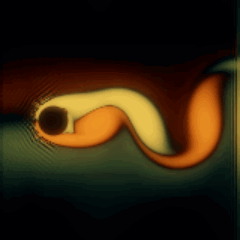
Put a body in a moving fluid and, past a certain speed, the wake stops being a wake and becomes a rhythm: vortices peel off one side and then the other in strict alternation, and drift away downstream as a staggered double row. Henri Bénard photographed those rows in 1908 and measured their spacing. Theodore von Kármán asked in 1911 which arrangements of such a row can survive at all, and found that almost none can — a symmetric pair of rows tears itself apart, and among the staggered ones only a single ratio of spacing to separation is stable. That is why the pattern behind a bridge pier and the one a satellite photographs behind an island look like the same object. The frequency is the other invariant: multiply it by the width of the body, divide by the speed of the stream, and the answer sits near two tenths across an enormous range of conditions, which is why a vortex flowmeter can weigh a gas by counting and why a wire in wind sings a note set by the wind rather than by the wire. Below a Reynolds number of about forty-seven none of it happens — the wake is two steady lobes, symmetric about the centreline, and stays that way forever. That threshold is the first slider, and crossing it is the exhibit. What computes the flow here is not the equations of motion discretised but a lattice of fictitious particles: nine numbers to a cell counting how much is moving in each of nine directions, each relaxed a fixed fraction of the way toward the local equilibrium and then handed on to the neighbour it points at. Do only that, and the Navier–Stokes equations come out anyway, with a viscosity set by the fraction — which is the whole of the method, and why nine numbers can hold a fluid. The body is a set of cells that reverse whatever reaches them, so the flow meets a staircase rather than a circle; the drawing shows the circle the staircase was cut from — the same smoothing the field itself is shown through — and the wall the fluid feels is never more than half a cell from the line drawn. Plate 115 also draws vortices; the difference between the two plates is this one, because there the vortices are given and drift under one another in an ideal fluid, and here a viscous fluid makes its own against an obstacle. Colour is the sense of rotation, so the two rows of the street are the two bright halves of the order palette either side of black. And the lattice counts its own shedding as it runs: every few seconds the plate reports the Strouhal number it has just measured.
PROVENANCE
- Origin — the observation
- H. Bénard, "Formation de centres de giration à l’arrière d’un obstacle en mouvement", Comptes Rendus hebdomadaires des séances de l’Académie des Sciences 147, 1908, 839–842, with a second note at 970–972. Bénard photographed and measured the alternating rows three years before the stability theory, which is why the French literature calls this the Bénard–von Kármán instability and why he is named first here
- Origin — the theory
- Th. von Kármán, "Über den Mechanismus des Widerstandes, den ein bewegter Körper in einer Flüssigkeit erfährt", Nachrichten von der Gesellschaft der Wissenschaften zu Göttingen, Mathematisch-Physikalische Klasse, 1911, 509–517, with a second part in the same series in 1912 and a companion by von Kármán and H. Rubach in Physikalische Zeitschrift 13, 1912, 49–59. The content is a stability calculation on an idealised double row of point vortices, not a picture of a wake: it asks which spacings survive, and answers that essentially one does
- The method, and it is a second lineage
- The flow is solved by the lattice Boltzmann method, which descends from the lattice-gas automata of U. Frisch, B. Hasslacher and Y. Pomeau, Phys. Rev. Lett. 56, 1986, 1505–1508 (doi:10.1103/PhysRevLett.56.1505). The collision used here is the single-relaxation-time operator of P. L. Bhatnagar, E. P. Gross and M. Krook, "A Model for Collision Processes in Gases. I", Phys. Rev. 94, 1954, 511–525 (doi:10.1103/PhysRev.94.511), and the nine-velocity square lattice with these weights is the D2Q9 model of Y. H. Qian, D. d’Humières and P. Lallemand, "Lattice BGK Models for Navier-Stokes Equation", Europhysics Letters 17, 1992, 479–484 (doi:10.1209/0295-5075/17/6/001). Implemented from the published equilibrium and collision, never from any solver
- Standing
- Public domain — a nineteenth-century equation of motion, a 1911 stability calculation, and two published numerical methods. No patent has ever applied to any part of it
- No source link
- The plate is about von Kármán 1911, which predates DOIs by eighty years, and this atlas prints no link it cannot verify against title, author, year and venue at once. The three method papers do have DOIs and they are written out above rather than turned into the plate source, because a reader clicking the source of a plate called Kármán Vortex Street should not land on a paper about collision operators
- The onset, measured on this lattice
- Vortex shedding begins at a Hopf bifurcation, so the saturated oscillation amplitude squared is linear in the Reynolds number just above it — the Stuart–Landau law, and the method by which M. Provansal, C. Mathis and L. Boyer located the threshold experimentally (J. Fluid Mech. 182, 1987, 1–22, doi:10.1017/S0022112087002222). Fitting that law to this lattice puts its own threshold at Reynolds 47.2, with the wake measurably steady at 46, still transient at 48 after 140,000 lattice steps, and saturated at 49. The accepted free-stream figure is about 47
- The frequency, and a discrepancy run to ground
- This plate measures a Strouhal number near 0.23 at Reynolds 150, where a cylinder in an unbounded stream gives about 0.183 (A. Roshko, NACA Report 1191, 1954; C. H. K. Williamson, Annu. Rev. Fluid Mech. 28, 1996, 477–539, doi:10.1146/annurev.fl.28.010196.002401). Twenty-five percent is too much to leave unexplained, and it separates cleanly into two candidates. Holding the blockage fixed and varying the body from 12 cells across to 28 moves the Strouhal number by 0.8 percent — so it is not the resolution. Holding the body fixed and varying the blockage from 20.8 percent down to 4.5 percent moves it from 0.266 to 0.193, and extrapolating to zero gives 0.176 against the literature 0.182. The whole difference is that the lattice wraps: this is an infinite row of cylinders, not one alone, and a confined row sheds faster. The measurement is the plate being honest about its own domain rather than a defect in it
- What the lattice measures about itself
- D2Q9 needs nine of the twelve channels three RGBA planes provide. The other three are an instrument: every fluid cell carries a hysteresis trigger on its transverse velocity, and a cell in the wake flips it exactly twice per shedding period. Counting in the state rather than sampling a probe means the frequency can be read with one lattice readback every 2,400 steps instead of one every few frames. The estimator is the mean over the cells that crossed rather than their median, which was measured rather than assumed: against a period found from a directly recorded probe series, the mean is right to within 2.1 percent from a single window at every Reynolds number on the slider, while the median is out by as much as 13, and accumulating medians never converges because the error is systematic rather than random. The number the plate prints carries that two percent. Counting is also what makes the onset unambiguous: below the threshold the transverse velocity in the wake is large but steady, around 28 percent of the free stream, so an amplitude test would have to be threaded — while the number of cells that change sign at all is exactly zero below and every one of them above
- Stability, measured
- The BGK collision relaxes every mode at one rate, and the viscosity is (τ − ½)/3, so a Reynolds ceiling is a relaxation-time floor and the method loses its stability as τ approaches ½. The corner of the declared box that pushes τ lowest — the slowest inflow with the smallest body — was driven to three times the top of the Reynolds slider without a single non-finite cell: stable at τ = 0.5023 and broken at τ = 0.5018, against τ = 0.5069 at the corner of the box itself. The check is on the field rather than on the picture, deliberately, because a lattice Boltzmann blow-up does not darken a plate, it saturates one, and every liveness probe passes a plate that is showing nothing
- The Mach number, which is the real limit
- Lattice Boltzmann recovers the equations of fluid motion only to second order in the Mach number, so the inflow speed is an accuracy dial and not only a pacing one. At the published constants the peak Mach number is 0.24 and the density varies by 2 percent; at the corner of the box with the fastest inflow and the largest body it reaches 0.37 and 5 percent. Everything remains stable there, and it is also where this plate is least entitled to be believed
- The forcing is ours
- Bénard and von Kármán described the flow; the initial transverse push behind the body is a staging decision added here. The instability is convective early on, so a wake left to grow out of round-off takes some forty thousand lattice steps to become a street, against about two thousand with a kick — and the hand of the kick comes from the seed, so regenerating starts the street the other way up. The same admission ripple makes about its rain
- Constants
- The Reynolds number is the only number this flow has, so it is the first slider and the relaxation time follows from it. The inflow speed sets how fast the plate runs and how compressible the model is being. The body radius sets both how well the obstacle is resolved and how much of the frame it blocks, which is the dial that moves the Strouhal number most. The lattice is neither resolution nor pattern scale here but domain: the body diameter and the speed are fixed in lattice units, so a larger lattice is more room around the same flow — the opposite of the Gray–Scott dial, and not quite the same as the Stam one either